Planning vs. doing: how do you turn ideas into reality?
Turn ideas into real projects: define your goals, build a timeline, break down tasks, bring people in and evaluate the results. Get moving!
 By Mariana Sierra Published Jul 29, 2020 Updated Dec 2, 2024 7 min read
 >>In a hurry?
In this post, I share my take on how to turn creative ideas into concrete projects, highlighting how important it is to clearly define what you want to achieve by writing down essential questions like "What?", "Why?" and "For whom?". I suggest building a logical timeline and breaking the project into smaller steps to make it easier to execute and to stay motivated. I also point out the value of bringing other people in, but with time limits to avoid endless postponing, and I stress that it's fine to take time to finish a project, as long as you keep moving forward on the simpler steps. At the end, it's crucial to evaluate whether the main goals were met, staying organized throughout the process.
I notice that a lot of very creative, observant, inspired people can't get past the idea stage and end up frustrated when they find themselves stuck, unable to take action and make a personal or professional project happen. So many ideas come up every day, so where do you start to actually get them out of the infinite world of thoughts?
I've tried to briefly describe how I think things through from start to finish, and I hope it inspires you to follow a line of thinking that gets things moving. The important thing is to try it out on one of your own projects to see what could be adapted, and to bring in your own preferences and possibilities.
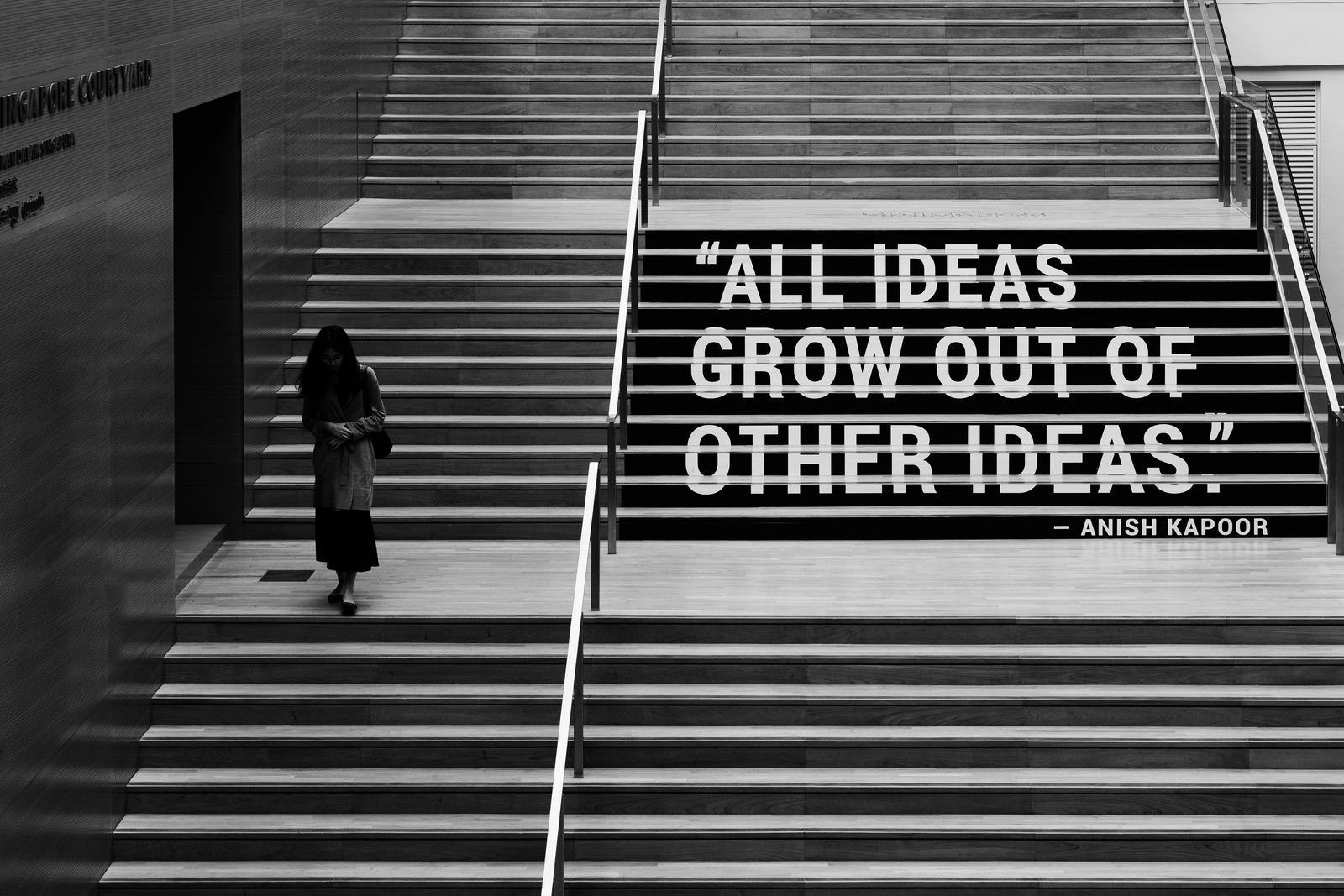
All ideas are born from other ideas. - Anish Kapoor
Start at the end.
I'm not kidding: you need to be very clear about what you want to do in order to really get unstuck and start producing. Writing and drawing help me a lot at this stage. Actually putting it on paper (or on a computer screen) helps you see the next steps more clearly.
The beginning is full of questions you ask yourself. Put all the answers you have together in one document, physical or digital. Some questions don't have answers yet, but you can write them down too, to spark some research.
Picture what you want to make as if it were already finished, and note everything involved in making it work. The most important questions are usually: What? Why? For whom? How big? With what resources? And for how long?
At this point, try to gather all the information you have about what you want to produce, and everything that's still missing. That way the idea becomes more tangible and takes shape so it can start moving.
Then work chronologically.
Once you've seen what the finished project looks like and you're clear on what you want to make, you need to start taking action. That means really sketching out each part of the project in an order that respects what has to happen first.
You can't paint a wall before you build it, and you can't build it before buying the materials, and you can't buy the materials before knowing what kind you need and where to find them, or what actually keeps a wall standing. So you need to lay out a timeline for the project.
I could call this step "make a schedule," but that sounds way too bureaucratic, especially if your project is personal and not for a client, for example. Even so, creating a logical order of things helps you always know what the next step is, and that's exactly what we're after: moving forward consistently until we have the final product.
Break the big picture into lots of small pieces.
Each step of the project can be described in different ways. Choose the most detailed one, broken into as many items as you can. Use lists.
The more items on your list, the more fun the next phase will be. Don't think the number of items equals the amount of work; that's not how it works. In fact, the more items you've planned, the surer you can be that you won't have to go back and redo a whole step because you forgot an important detail.
The more detailed everything that needs doing is, the fewer headaches you'll have and, as a result, the less work you'll throw away.
Get it out of the way.
At this point, you already know everything that needs to happen to make the project a reality, and this is usually where a lot of people stop, paralyzed by the number of tasks and subtasks that have appeared. But since we know a long task list doesn't necessarily mean a full day of work, we don't have to go down that road.
I usually finish my list of practical tasks before lunch and leave the more creative things, the ones that involve other people and the ones that generate new projects, for the afternoon, regardless of how big or how many projects I'm handling. That means what matters most is having everything organized, not having only a few things to do.
At this stage, your greatest pleasure is crossing things off the list, so start with the simplest and work your way up to the more complicated. Believe me, the more small goals you manage to hit, the more motivated you'll probably feel to keep going.
If one day you're not very motivated to do anything, look for something super simple on your list and at least try to do that. Usually, just starting and seeing that you managed to take one step forward is enough for motivation to kick in. If it doesn't, that's okay: every small step counts, and resting can be one of them. Be patient with yourself.
Figure out how to bring more people in.
Having other people working toward the same goal can really speed up the process of making something happen, not just because you have more hands on deck, but because it also creates a stronger sense of commitment for everyone.
Even so, it's important to know when to bring other people in, so it doesn't backfire and lead to the opposite result: putting things off forever.
During the creative phase, for example, people should be able to dedicate themselves fully, even if only for set periods of time and always with a deadline. Leaving this phase loose and at the mercy of several people's schedules is a great way to never get the project off the ground, even if it seems to be moving at first.
Once we're executing the practical things, this time control can be more flexible depending on the goal, because what matters most is completing tasks that have already been defined during the creative phase, and each step can be taken gradually.
When more people are involved, the key is never to forget who is leading the project. However many other people there are, one person has to be responsible for pushing the others and making sure things are moving. If the project is yours but you don't want to be that person, you'll need to hire someone, or have someone who is truly passionate about your idea, to take on that role. Another option is for you to lead the creative side and have an operations lead who keeps you and everyone else on track, but that person has to be really committed to the end result. Don't expect someone to push your project forward just because you asked nicely; it takes more commitment than that, whether emotional or financial.
Sometimes taking your time matters.
Many projects have a deadline, but many don't necessarily have one. See which is the case for yours and use it to your advantage. If you were hired to make something, you'll certainly have to meet the dates in the contract, but if it's a personal project, you can stretch the timeline in whatever way works best for you and for the project.
There's no need to beat yourself up because you still haven't finished a project you started a year ago. Each step naturally has its own right time. What matters most is making sure every step is written down and detailed, and that you're not putting off until tomorrow a super simple step that could move a lot forward.
If you need to send an email, you can do it now, but if you need to land a sponsorship, it can take a lot longer.
Sometimes the project's own path, and how long a certain step takes, can help you redesign the plan, and that also counts as progress. If the sponsorship didn't come through in a year, maybe there's another way to fund it, or to do it independently, that you hadn't considered yet. Is it time to change course?
The end isn't always the end.
When your idea is very close to coming out into the world, you can sometimes rush and miss details that would make all the difference. At the end, what matters most isn't the delivery itself, which is almost there without you doing anything, but using your motivation to evaluate whether the main goals were met.
If your project is finished but nobody heard about it, maybe your effort was wasted. Go back to the main goal behind it all, and don't let a great project sit in a drawer just because you were too tired to keep dealing with it.
Once again, what matters most isn't how long it takes, but being aware that there's still work to do to reach the goal you set for yourself.
Bringing people in at this stage can be a good strategy, because people who aren't worn out by the process may see potential you never imagined at the start. When you have everything almost ready, don't forget to reach out to everyone who might need it or make good use of it, so you can finally reach the goal you planned.
My main strategy is to stay organized to keep the wheel turning all the way to the end.
Over time, I've noticed that the more organized I can keep my thinking, the easier it is to keep things moving. You need to focus on the details to create the bigger thing. If you're unsure about what to tackle first, I recommend reading another post I wrote on that, "What needs to be done today?", which focuses more on organizing tasks.
I hope this has given you ideas on how to move forward with the projects you have inside you, and that new projects come along, because, as they say, if life is the journey, what matters is to keep moving, and nothing will have been in vain.
Good luck!
Want personalized help? Get in touch and let's talk!
Comments
No comments yet. Start the conversation.